

Putting the Maths into History
...with a small tweak to the Elizabethan England GCSE syllabus
18 May 2026
Do maths and history go together? Absolutely.
Last weekend Tom Briggs, Elinor Flavell and I hosted a stand at the Historical Association conference in Gateshead. We spoke to dozens of history teachers and general historians about ways in which maths, numeracy and history are intertwined, and how those connections can be brought into school lessons. We focused on Elizabethan England, where exploration, trade, warfare and even gambling were closely connected to the mathematical education of the time.
We also ran a prize competition based on a hypothetical History of Maths GCSE, which we handed out to almost 100 delegates. Their challenge was to attempt the multiple choice questions in Section A, and lots of them did. You can see the paper here. (The answers to Section A are at the bottom of this page).
The main thing that we took away from the weekend is that there is a real interest in this topic. Teachers immediately saw opportunities to incorporate mathematical ideas into their lessons. The response online has also been striking, with positive feedback from maths teachers, history teachers, general educators and (to my surprise) lots of Year 11 and Year 12 students too.
There's been plenty of love in the comments:
"I would LOVE to do such an exam"
"My history teacher friends are loving this"
"I have always wanted to do a maths history course"
And my favourite...
"I bloody love this! As a tutor of both history and maths it's just brilliant."
So what next?
The reality is that in a crowded curriculum this remains just a thought experiment. Most teachers simply don't have time to add enrichment unless it clearly supports exam content. What seems to matter above everything else is:
THINGS THAT GET YOU MARKS IN A GCSE
If this is going to become more than a niche idea, we need exam boards to tweak their mark schemes to make it clear that some knowledge of the mathematical developments of the 16th century will earn credit.
One obvious starting point would be the transition from Roman to Indo Arabic numerals, which in England took place in the late 1500s, around the time of Shakespeare. The change was driven by the growth of trade, exploration and naval warfare. It's historically important, mathematically rich and, perhaps most importantly, students find it genuinely interesting.
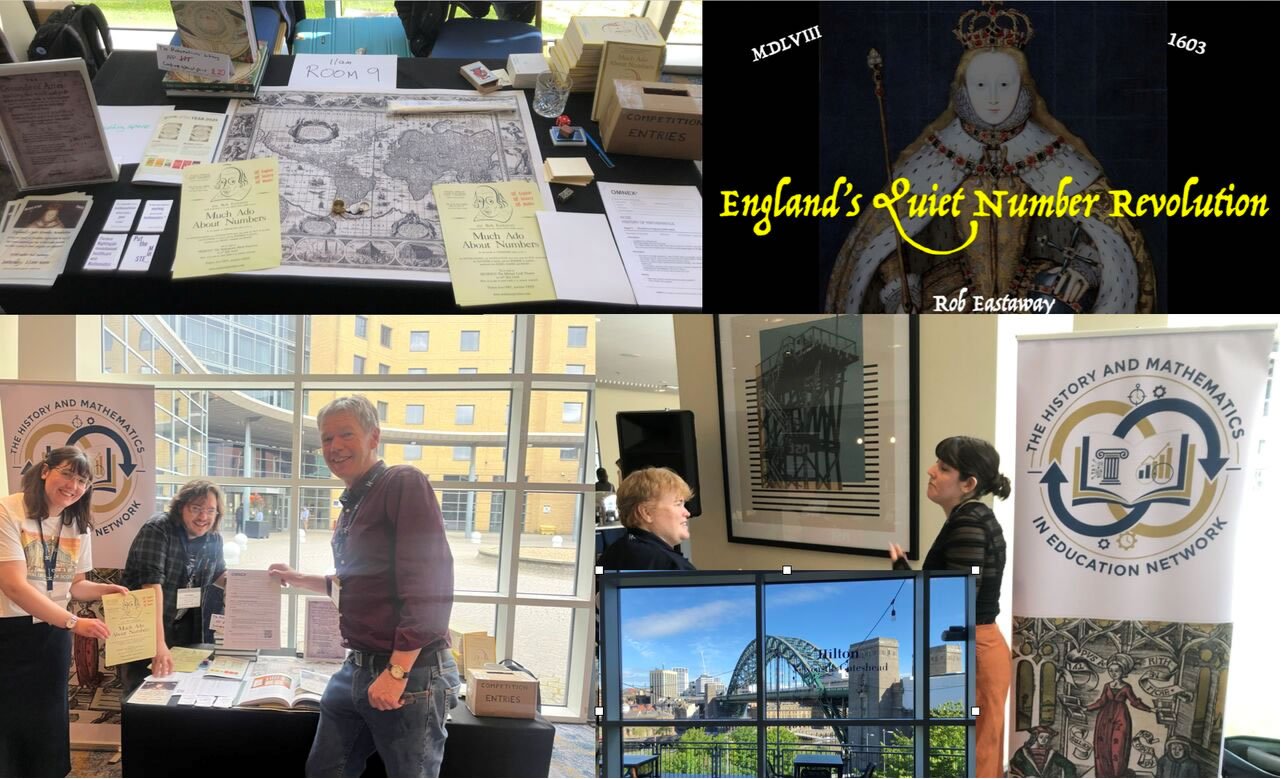
Our Exhibitor stall at the Historical Association conference in Gateshead, May 2026.
Answers to Section A:
1. (c) Furlong (one eighth of a mile). Chains did not become statutory until a few years later, and metres didn't arrive until 200 years later. One league was about three miles but never an official measure.
2. (b) The Act was to ensure fair trade and standardise measurements like the mile.
3. (a) There were twelve ounces in a Troy pound, used for measuring silver and gold. There were, and still are, twelve inches in a foot (not a yard) and twelve pennies in a shilling (twenty shillings in a pound)
4. (d) The fourth mathematical subject was music. Shakespeare makes frequent references to the mathematical nature of music.
5. (c) University lectures were all given in Latin, as were grammar school lessons.
6. (d) None of the above. Mathematics lectures were almost entirely oral, teachers had few if any visual aids, though students did have access to books.