

Cabinet Conversation
Meeting dynamics are influenced by the shape of the table.
08 January 2026
Every so often I get a really unusual enquiry about maths. Yesterday it was a call from BBC Radio 5Live, asking if I had any views on the shape of the table that is used by the UK government for their Cabinet meetings in Downing Street.
It should come as no surprise that I've never given this any thought before. I was aware that the Cabinet sit around a long thin table, but that's about it.
Anyway, it turns out that it's not simply a rectangular table, and there's a good reason for this. The problem with a rectangular table is that it's difficult to make eye contact with people who are on your side of the table at the other end of the room. And for serious conversation, eye contact is important. To be able to see the people to the side of you, the edge of the table needs to be curved.
The optimal 'fair' table shape for eye contact is a circle, because it means everyone has an equal share of visibility. It's not perfect, however. If you're all spaced evenly around the table, the person opposite you subtends a bigger angle to you than those to your side, who will appear more squished together. I'm not sure there's a way to improve on this in a way that's fair to everyone, but then at most meetings people don't usually have equal status anyway. The relative visibility that people have of each other influences their status in the meeting. If I can see you full on, you're likely to feel more important to me, and I can also influence you more. If you only occupy a narrow sliver of my field of vision somewhere off to the side we influence each other less.
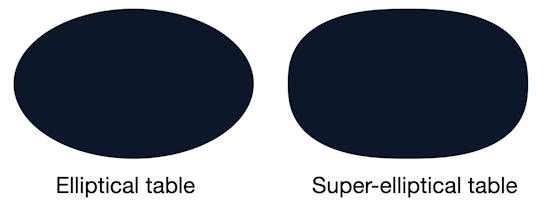
If a round table is going to fill a room then the room needs to be square. However the Cabinet Room in Downing Street is rectangular, which means the best shape for the Cabinet table is going to be some sort of oval. But which type? Mathematically the most satisfying shape is an ellipse, and for a room of length L and width W there is a unique ellipse that will fit it perfectly.
Wait, you want to see the formula? OK, here it is:

There are other curved shapes too. You can get ones that are a bit more rectangular and fill the room more, including what's known as a superellipse. For a room of fixed dimensions you can fit more cabinet members around a superelliptical table than around an elliptical table, because there will be less wasted space at the corners of the room.
So what shape IS the Cabinet's table? It turns out that it has straight edges rather than curves, but it has an elliptical feel to it because there's are kinks in the sides. In fact mathematicians* would call it an irregular, symmetrical octagon - it has eight sides, six of them appear to be about 10ft long, and the two ends are about 5ft long, as the 2019 photo below shows.

The Prime Minister sits at the centre of one of the long sides, which minimises the distance between the PM and the member who is seated furthest away. The downside of this is that the people sitting on the same side of the table as the PM have a very oblique view and probably have to lean into the table if they want to make eye contact.
If you want the attention of the PM, it definitely helps to be seated fairly centrally on the opposite side of the table. Geometry doesn't just shape tables, it shapes power too.
* I wasn't able to do the interview on 5Live, but I was delighted that mathematician Ayliean MacDonald picked it up, and did a better job than I would have done in defining the shape.